
AYVAKYT demonstrated improvement in organ function1,2

- 1-year prespecified analysis
- PATHFINDER 4-year descriptive data
At 1 year, AYVAKYT met the primary endpoint with an ORR of 60% in PATHFINDER1*
In evaluable Advanced SM patients who received at least one prior systemic therapy and a starting dose of 200 mg (n=47):1**

*The null hypothesis ORR of 28% versus the alternative hypothesis, ORR of 50%, a one-sided type I error rate of 0.025 and a sample size of approximately 63 patients in cohort 1 were determined to have 93.5% power using the exact one-sample binomial test.3
**Based on data cut: 20 April 2021.4
AYVAKYT demonstrated efficacy across all Advanced SM subtypes1


Of particular note is the strong efficacy in SM-AHN, as this is a common subtype of Advanced SM seen in clinical practice5
Secondary endpoints: AYVAKYT demonstrated rapid responses that deepen over time1
Patients who received AYVAKYT at a starting dose of 200 mg once daily:1
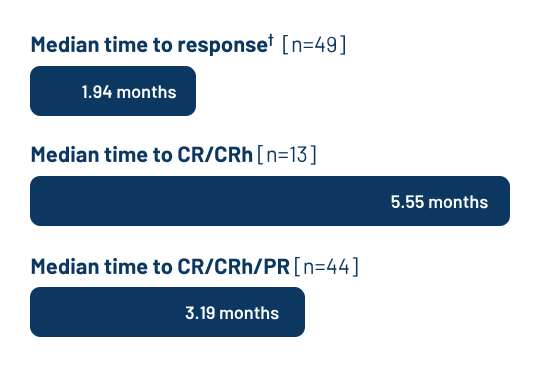

†Includes CR, CRh, PR and clinical improvement.
‡Estimated from Kaplan-Meier analysis.
CR=complete response; CRh=complete remission with partial haematological recovery; DOR=duration of response; PR=partial response
Over 65% of patients achieved at least 50% reduction in mast cell burden across the 1-year analysis1
Among Advanced SM patients treated with AYVAKYT at a starting dose of 200 mg once daily following prior systemic therapy:1
88.1%
≥50% reduction in serum tryptase level [n=67]§
83.1%
≥50% reduction in bone marrow mast cells [n=65]
60.0%
≥35% reduction in spleen volume from baseline [n=65]
68.7%
≥50% reduction in KIT D816V MAF in blood [n=67]
§To achieve a CR and CRh, serum tryptase had to be <20 ng/mL if the baseline value was ≥40 ng/mL.3
MAF=mutant allele function
AYVAKYT achieved durable overall response in organ function over 4 years2
In evaluable Advanced SM patients who received at least one prior systemic therapy (n=53; median follow-up duration was 51.8 months):2*
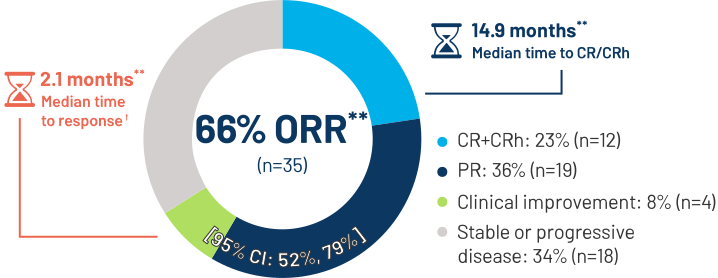
AYVAKYT demonstrated response across all Advanced SM subtypes, with ORRs of 75% (n=6), 67% (n=22) and 58% (n=7) in ASM, SM-AHN and MCL, respectively2
*Based on data cut: 13 March 2025.2
**Based on the full population of evaluable patients with at least one prior systemic therapy (n=53).2
†Includes CR, CRh, PR and clinical improvement.2
AYVAKYT prolonged overall survival in Advanced SM2
In response-evaluable patients who received at least one prior systemic therapy (n=53):2*
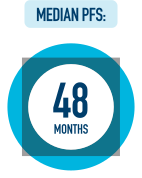
[95% CI: 31, 62]
Median PFS was not reached in patients with ASM or MCL
In the safety population who received at least one prior systemic therapy (n=69):2*
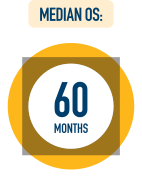
[95% CI: 48, NR]
Median OS was not reached in patients with ASM or MCL, and those with low and intermediate MARS score.‡ Patients with a high MARS score (n=41) had a median OS of 48 months (95% CI: 23, NR)
‡MARS is a five-variable prognostic score using one point each for age >60 years, anaemia (haemoglobin <10 g/dL), thrombocytopenia (platelets <100 x 109/L), one S/A/R mutation, and one additional point for ≥2 S/A/R mutations; low score = 0–1, intermediate score = 2, high score = 3–5.7
MARS, mutation-adjusted risk score; NR, not reached; OS, overall survival; PFS, progression-free survival
Over 80% of patients achieved at least 50% reduction in mast cell burden across the 4-year analysis2
Reductions in objective biomarkers of disease were observed in the safety population with baseline and post-baseline assessments:§
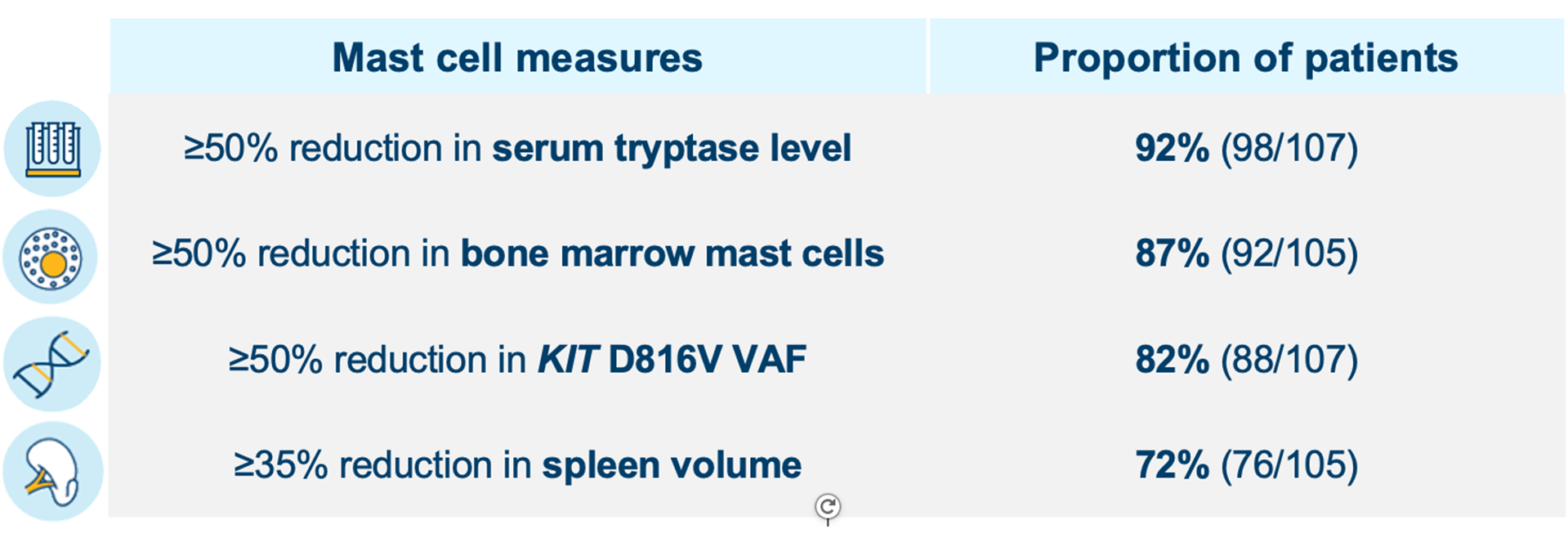
§Available n=107 for serum tryptase and KIT D816V measurement; available n=105 for spleen volume and bone marrow mast cells measurement.
VAF=variant allele fraction.

