
Patients with Advanced SM experience organ damage which can lead to shortened overall survival1–3
Advanced SM is a rare clonal mast cell neoplasm4
Advanced SM has an estimated prevalence of ~1 in 100,000 and it commonly affects adults5

Mast cell infiltration in Advanced SM may lead to debilitating symptoms and progressive organ dysfunction that significantly impacts daily life1,4
Patients with Advanced SM can suffer from severe and often life-limiting organ damage, including ascites, osteolytic bone lesions, liver dysfunction, weight loss, cytopenia, and hypersplenism1,6,7
Historical median OS for patients with Advanced SM2*
Figure adapted from Lim et al. 2009
*OS was examined in a retrospective study of 342 consecutive adult patients with SM at the Mayo Clinic between 1976 and 2007.2
Mechanism of Disease
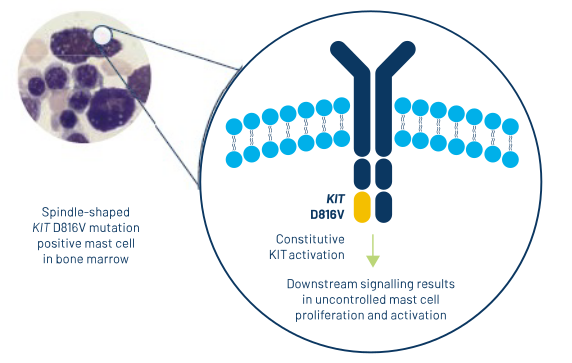
Advanced SM is driven by KIT D816V mutation in ~95% of cases; however, until recently, there were no treatment options that selectively targeted this underlying mutation4–8
The KIT mutation constitutively activates downstream pathways regulating cellular functions including proliferation and survival of abnormal mast cells9,10

